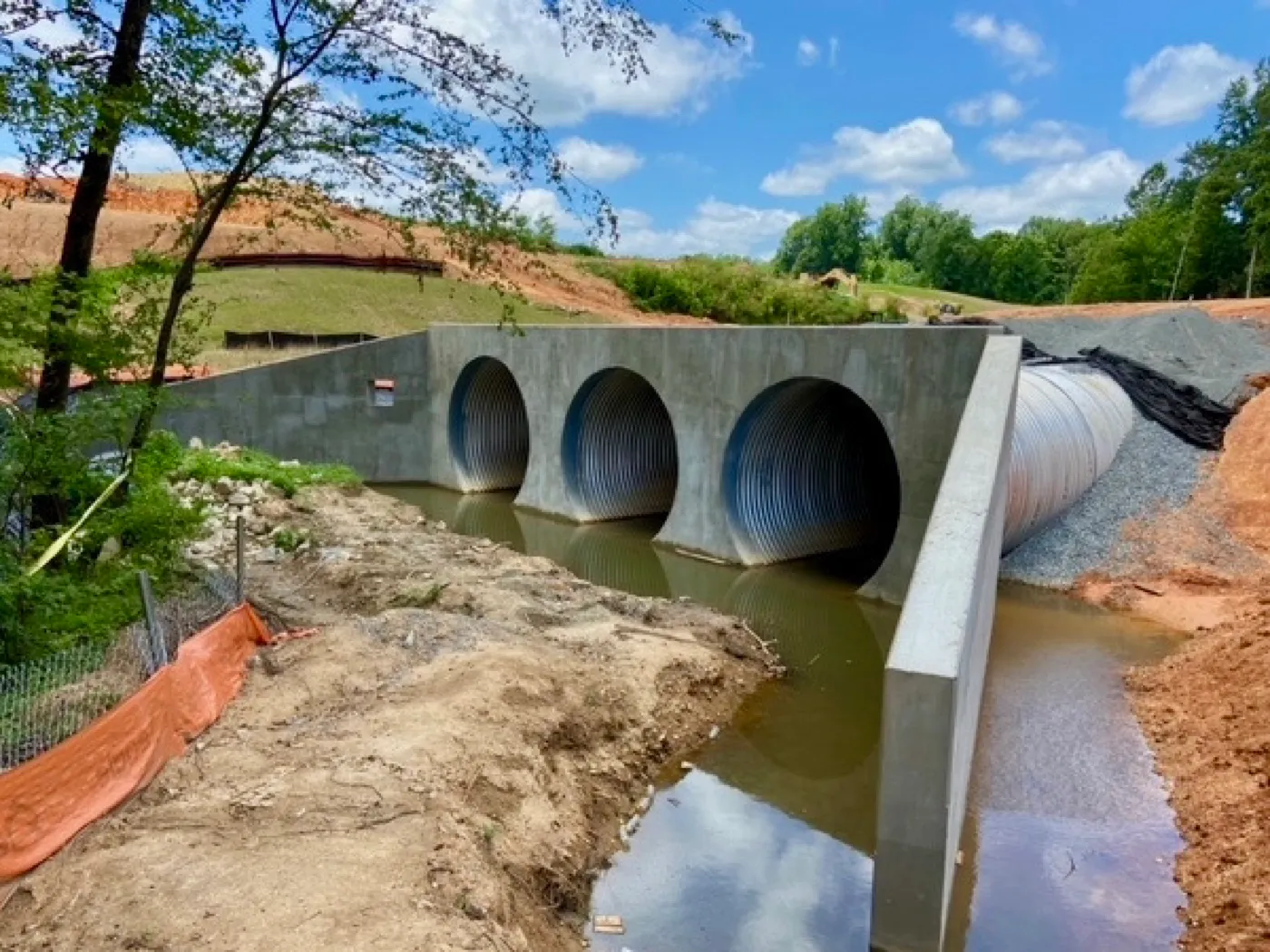
Culvert Inspection Services
Carolina Infrastructure Assessment delivers comprehensive culvert inspections for corrugated metal pipes, reinforced concrete pipes, and box culverts across North Carolina, Virginia, Maryland, and Washington, D.C., with 5-day photo-documented condition reports.
Defect classification and structural integrity ratings aligned with federal culvert inspection guidelines.
Physical crawl evaluations for CMP, RCP, and box culverts detecting invert corrosion, joint gaps, and voids.
Executive 2-page A–F Report Card with photographic defect log delivered in 5 business days.
Detecting Underground Defects Before Pavement Collapses
Underground drainage culverts are often out of sight and out of mind until pavement deflections, sinkholes, or catastrophic roadway washouts occur. The federal National Bridge Inventory generally catalogs only public highway structures with spans exceeding 20 feet, leaving thousands of culverts under private streets, neighborhoods, and commercial properties unmonitored.
Our field inspectors perform thorough external and internal barrel crawl evaluations to inspect the full length of pipes, box culverts, and headwalls. We pinpoint invert corrosion, joint separation, soil piping, and subgrade voids before water undermines the roadway foundation.
Every assessment delivers an executive 2-page Report Card paired with photographic defect logs and repair prioritization schedules within 5 business days.
Independent Condition Documentation
We provide objective evaluations without ties to construction contractors, ensuring your board or municipality receives honest condition ratings and realistic maintenance timelines.
Culvert Components Evaluated
Detailed inspection protocols covering critical structural, hydraulic, and safety elements.
Internal Barrel Condition
- Full-length internal crawl inspections for accessible pipe barrels and boxes
- Invert corrosion, pitting, section loss, and metal perforation
- Joint separation, gasket degradation, and subgrade soil infiltration
- Concrete cracking, spalling, shear displacement, and efflorescence
Inlets, Outlets & Headwalls
- Headwall, wingwall, and apron structural integrity and alignment
- Debris accumulation, trash rack blockage, and inlet flow constriction
- Outlet scour holes, downstream undermining, and apron failure
- Flap gate, tide gate, and outfall restrictor plate operational status
Overlying Roadway & Embankment
- Pavement dips, longitudinal cracking, and localized subgrade deflection
- Embankment slope washouts, piping holes, and localized sinkholes
- Guardrail post foundation support adjacent to culvert headwalls
- Vegetation overgrowth, root penetration, and bank erosion channels
Hydraulic & Channel Performance
- Upstream sediment buildup and constriction of active barrel flow area
- Downstream channel degradation and localized bank scour
- High-water debris lines indicating potential backwater or overtopping
- Stormwater discharge channel alignment and energy dissipation
Culvert Types We Regularly Inspect
Crossings and drainage facilities evaluated across private, commercial, and municipal properties.
Corrugated Metal Pipe Culverts (CMP)
Galvanized steel and aluminized corrugated metal pipes and pipe arches, commonly installed during 1980s through 2000s residential development.
Reinforced Concrete Pipes (RCP)
Precast circular and elliptical concrete pipe runs ranging from 18 to 72 inches, evaluated for joint separation and bell-and-spigot alignment.
Reinforced Concrete Box Culverts (RCBC)
Single-cell and multi-cell precast or cast-in-place box culverts conveying major stream flows beneath residential roadways and parking areas.
Structural Plate Arches & HDPE Storm Pipes
Bottomless structural steel arches set on concrete footings, smooth-interior corrugated polyethylene storm pipes, and legacy stone masonry arches.
Common Culvert Deterioration Patterns
Early-stage deterioration patterns identified before structural capacity is compromised.
Invert Corrosion & Perforation
Runoff water and sediment wear away the protective invert coating of metal pipes, causing rust holes that allow water to wash away road subgrade.
Joint Separation & Soil Piping
Ground settlement or hydraulic pressure pulls pipe joints apart, drawing road base soil into the culvert and creating hazardous hollow voids beneath asphalt.
Headwall Scour & Undermining
Uncontrolled turbulence at pipe inlets or outlets undermines headwall footings, leading to structural rotation, cracking, and eventual embankment collapse.
Pavement Deflection & Sinkholes
Visible surface depressions and dips over pipe crossings indicate that the culvert barrel has deformed or subgrade support has already washed away.
Who Relies on Our Culvert Inspections
Tailored inspection deliverables designed for both lay board members and municipal engineering staff.
Homeowner Associations & Property Boards
HOA boards responsible for private subdivision roads evaluate aging corrugated pipes to prevent catastrophic sinkholes, roadway closures, and costly emergency repairs.
Municipal Public Works & Stormwater Divisions
City and town stormwater staff verify infrastructure conditions to support NPDES MS4 permit compliance and allocate stormwater capital improvement funds.
Commercial Centers & Industrial Facilities
Facility managers assess drainage conduits beneath parking lots, loading bays, and perimeter access drives to protect commercial operations.
Golf Courses & Private Clubs
Course managers inspect drainage crossings beneath cart routes and fairways to prevent turf collapses, bank erosion, and pond overflow issues.
Inspection Deliverables
Every evaluation includes comprehensive documentation delivered digitally within 5 business days of the field assessment.
Executive 2-Page A–F Report Card
A clear, concise condition summary with component letter grades, risk ratings, and plain-language findings created for non-technical board members.
Internal Barrel Photographic Log
Complete photo documentation from inlet to outlet, detailing every isolated crack, separated joint, rust perforation, and sediment blockage.
Prioritized Repair Matrix
Action items ranked by urgency, distinguishing between critical structural hazards requiring immediate action and routine preventative maintenance.
Hydraulic Condition Summary
Measurements of active flow capacity, sediment depths, and channel erosion patterns to guide municipal maintenance crews or site contractors.
Regional Inspection Coverage
We provide scheduled field evaluations across four Mid-Atlantic jurisdictions. Select your region to view local coverage and scope.
North Carolina
Scheduled field dispatch across the Piedmont Triad, Research Triangle, and Charlotte corridors, evaluating vehicular bridges, pedestrian trail crossings, and roadway drainage culverts.
Virginia
Responsive regional routing across Fairfax, Arlington, Alexandria, and Northern Virginia, providing condition assessments for roadway crossings, pedestrian spans, and drainage culverts.
Washington D.C.
Dedicated urban routing throughout Washington, D.C., delivering independent condition assessments for campus pedestrian bridges, commercial access spans, and enclosed drainage networks.
Maryland
Regular coastal and inland dispatch across Salisbury, Ocean City, Cambridge, and Easton, evaluating access bridges, corrugated drainage culverts, and tidal stormwater discharge outfalls.
Frequently Asked Questions
Direct answers about our culvert inspection protocols. Have a specific structure question? Give us a call.
What are the early warning signs that a culvert needs inspection?
Key warning signs include localized dips or cracks in the pavement directly above the culvert, standing water ponding upstream after storms, erosion or washouts around headwalls, rust staining in water flows, and sinkholes developing in roadway shoulders or yards.
Who is legally responsible for inspecting culverts under HOA roads?
When neighborhood streets have not been formally accepted into the state highway maintenance system or municipal public street network, the streets and underlying drainage pipes remain private property. The HOA or property management company is responsible for all inspection, maintenance, and repair costs.
What is the difference between a pipe camera and a hands-on culvert inspection?
CCTV pipe cameras provide basic video feeds, but a hands-on physical crawl inspection allows an NBIS-certified inspector to feel joint displacements, probe invert steel thickness, test concrete hardness, and evaluate external headwalls, embankments, and stream scour patterns.
Can you assist with municipal MS4 outfall permit obligations?
Yes. We perform condition evaluations, photographic logs, and structural integrity assessments on stormwater discharge headwalls, wingwalls, and outfalls to support municipal NPDES MS4 permit compliance documentation.
How quickly are culvert inspection reports delivered?
Complete digital inspection packages, including the executive 2-page A–F Report Card and high-resolution defect logs, are delivered within 5 business days of the field visit.
Schedule a Culvert Inspection
- Scheduled in 1–2 weeks.Most inspections are on the calendar within two weeks of your first call.
- Reported in 5 days.Your full report and Report Card arrive digitally within 5 business days.
- 20% off your first inspection.Ask about our Founder's Program for first-time clients.
Speak directly with an NBIS-certified program manager about your crossings or drainage structures. 15-minute scoping calls and standard 5-day turnarounds.
- Phone
- (336) 653-1866
- Location
- Greensboro, NC